
Ukuleles available from Square Music Company.


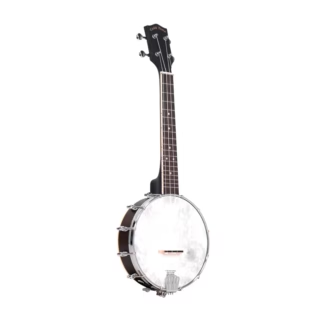
$279.99
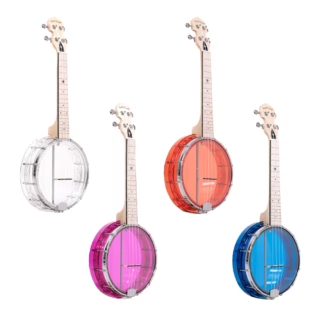
w/Padded Gig Bag, Color Variety

Tenor Ukulele
$599.99
w/Padded Gig Bag
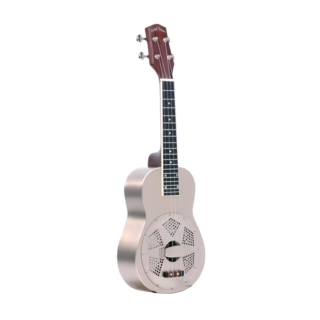

The Ukulele: A Little Instrument with a Big History
The ukulele, a charming and highly portable stringed instrument, often brings to mind images of Hawaiian beaches and laid-back musical vibes. Though small in stature, its distinctive bright and cheerful sound has captivated musicians and listeners worldwide. Essentially a member of the lute family, the ukulele is characterized by its four strings, typically tuned to G-C-E-A, with the G string often tuned an octave higher than one might expect, creating its signature re-entrant tuning. This unique tuning, combined with nylon or fluorocarbon strings, contributes to its light, airy, and remarkably distinct voice. Unlike a guitar, which often aims for a full, resonant low end, the ukulele excels in the mid to high registers, making it an excellent accompaniment instrument for vocals and a delightful solo instrument for melodic lines. Its compact size makes it incredibly accessible for beginners of all ages, as well as a convenient travel companion for seasoned players.
The story of the ukulele is a fascinating tale of cultural adaptation and musical innovation, beginning in the late 19th century in Hawaii. The instrument's roots can be traced back to the machete de braga and the cavaquinho, small guitar-like instruments brought to the Hawaiian islands by Portuguese immigrants from Madeira in the 1880s. Three master craftsmen; Manuel Nunes, José do Espírito Santo, and Augusto Dias are credited with adapting these instruments to local tastes and resources, inadvertently creating what would become the ukulele. The Hawaiians quickly embraced the new instrument, captivated by its lively sound and ease of play. Its name, "ukulele," is often translated as "jumping flea," perhaps referring to the rapid movement of a player's fingers across the fretboard, or more romantically, as a gift that "came from afar." Royal patronage, particularly from King Kalākaua, significantly boosted its popularity within Hawaii, transforming it from a folk instrument into a symbol of Hawaiian culture. Its international fame truly blossomed in the early 20th century, particularly after the Panama-Pacific International Exposition in San Francisco in 1915, where Hawaiian musicians showcased the instrument, sparking a mainland U.S. craze that ebbed and flowed but never truly disappeared, experiencing a significant resurgence in recent decades.
The construction of a ukulele, while appearing simple, involves precise craftsmanship to achieve its characteristic sound and playability. Like other stringed instruments, it comprises a body, a neck, a headstock, and strings, but scaled down to its compact dimensions. The body, which forms the resonant chamber, is typically made from various tonewoods, with koa wood being the most traditional and highly prized, especially for Hawaiian-made instruments, known for its beautiful grain and bright, clear tone. Other common woods include mahogany, spruce, and cedar, each imparting slightly different tonal qualities. The body consists of a soundboard (top), back, and sides, often joined with internal bracing to enhance stability and projection. The soundhole, typically circular, allows the sound to emanate from the instrument.
Extending from the body is the neck, usually crafted from mahogany or maple, which provides the foundation for the fretboard. The fretboard, commonly made of rosewood or ebony, features metal frets embedded at precise intervals, allowing players to produce accurate pitches. Unlike guitars, ukuleles typically have fewer frets due to their smaller scale length. At the end of the neck is the headstock, which houses the tuning pegs or machine heads. These mechanisms allow players to tighten or loosen the strings, thereby adjusting their pitch. The four strings, traditionally made of gut (though now almost exclusively nylon or fluorocarbon), are anchored at the bridge on the body, pass over the saddle (which determines the string height), run along the fretboard, and are then wound around the tuning pegs. The tension of these strings against the soundboard, combined with the body's resonant properties and the unique re-entrant tuning, is what gives the ukulele its delightful and unmistakable voice.