
Banjos available from Square Music Company.


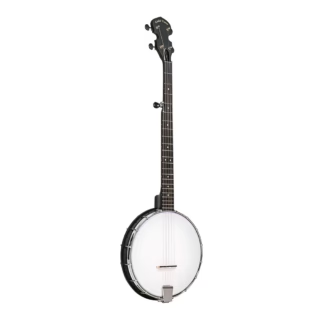
5-String Banjo
$399.99
w/Padded Gig Bag
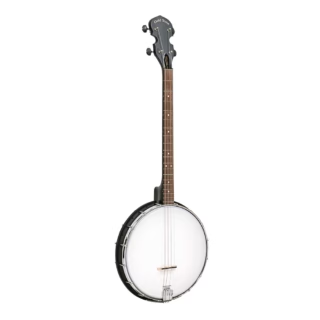
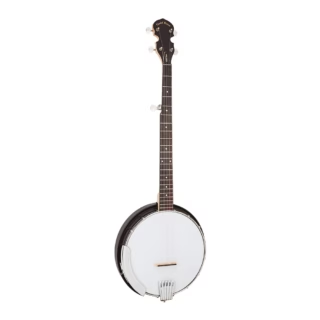
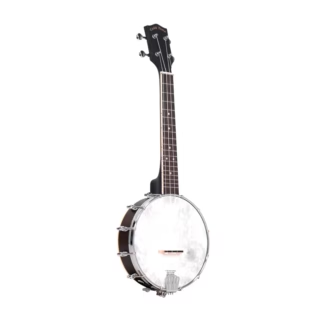

$279.99
w/Padded Gig Bag, Color Variety
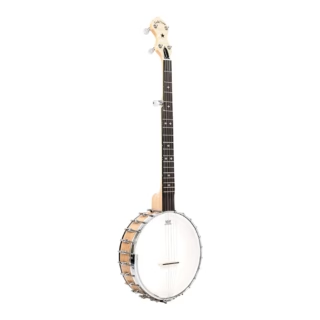
5-String Banjo
$1,533.32
w/Hard Case

The Banjo: A Resonant Journey Through History and Sound
The banjo, with its distinctive twang and bright, percussive sound, occupies a unique and significant place in the tapestry of global music. Far more than just a folk instrument, it has been a driving force in a multitude of genres, from early American minstrel shows and classic ragtime to the soaring bluegrass melodies and intricate old-time rhythms of today. At its core, a banjo is a stringed instrument characterized by its drum-like body, over which a membrane (or head) is stretched and tensioned, similar to a drum. This head, traditionally made of animal skin but now often synthetic, is crucial to the banjo's signature tone, providing much of its volume, brightness, and attack. Typically, banjos feature four, five, or six strings, with the five-string banjo being the most common in American folk traditions. Unlike guitars or ukuleles, many banjos also feature a short, higher-pitched drone string (the fifth string on a five-string banjo), which adds a characteristic ringing quality to its sound. This unique combination of a membrane head, a long neck, and often a drone string sets the banjo apart as an instrument with an unmistakable voice and a fascinating history.
The story of the banjo is deeply intertwined with the history of the African diaspora in the Americas. Its origins can be traced back to various stringed instruments brought by enslaved Africans to the Caribbean and the Southern United States, instruments that incorporated gourds or hollowed-out wood bodies with stretched animal skins. Early forms of the banjo, often called "banza" or "banjar," were instrumental in preserving African musical traditions and providing a vital source of expression and community for enslaved people. These early instruments were largely fretless, with players relying on their ear and dexterity. By the 19th century, the banjo had gained popularity beyond the enslaved communities, finding its way into minstrel shows, which, despite their problematic and racist caricatures, played a role in disseminating the instrument's sound across the United States and even to Europe. Post-Civil War, the banjo continued to evolve, becoming a staple in ragtime and early jazz. The early 20th century saw the rise of different banjo styles, including the four-string tenor banjo for jazz and the plectrum banjo, while the five-string variant began its journey towards its iconic status in country and bluegrass music, largely popularized by innovators like Earl Scruggs in the mid-20th century, whose three-finger picking style revolutionized the instrument's technique and sound.
The construction of a banjo is a blend of stringed instrument and percussion design, resulting in its unique acoustic properties. The most distinguishing feature is its pot assembly, which acts as the instrument's resonating chamber. This assembly typically consists of a wooden rim (often laminated maple or mahogany) with a tone ring resting on top. The tone ring, made of brass, bronze, or steel, is critical to the banjo's volume and sustain, acting as a crucial vibrating element that transfers string energy to the head. Over this rim and tone ring, the synthetic or natural skin head is stretched taut and held in place by a tension hoop and a series of hooks and nuts, allowing for precise adjustment of head tension, which profoundly affects the banjo's tone. A bridge, typically a small piece of wood, sits on the head, transmitting string vibrations to the membrane.
Extending from the pot is the neck, usually made of maple or mahogany, which is longer and narrower than that of a guitar or ukulele. The fretboard, commonly rosewood or ebony, features metal frets, though some traditional "old-time" banjos are still fretless. The number of frets can vary, but 22 frets are common for five-string banjos. A distinguishing feature of the five-string banjo is the fifth-string tuner, located midway up the neck, which controls the short, higher-pitched drone string. At the end of the neck is the headstock, which houses the remaining tuning machines for the other strings. The strings themselves, typically steel, are anchored at the tailpiece on the pot, pass over the bridge and nut, and are wound around the tuning pegs. The interplay of string tension, head tension, and the materials used in the pot assembly are what give each banjo its individual voice, from the bright, cutting tone of a bluegrass banjo to the mellow, plunky sound of an old-time clawhammer instrument, reflecting the instrument's diverse heritage and sonic capabilities.