
Mandolins available from Square Music Company

The Mandolin: A Resonant Gem of Stringed Tradition
The mandolin, a petite and often exquisitely crafted instrument, holds a unique place in the pantheon of stringed instruments, celebrated for its bright, ringing tone and rapid-fire melodic capabilities. Part of the lute family, the mandolin is essentially a smaller, higher-pitched relative of the guitar, distinguished by its typically eight strings arranged in four courses of two strings each. These courses are tuned in unison, most commonly to G-D-A-E, just like the violin, giving the mandolin its characteristic shimmering sound and allowing violinists to easily adapt to it. Players typically use a pick (or plectrum) to strike the strings, often employing a technique called "tremolo"—rapid up-and-down picking on a single note—to sustain the sound, a crucial element of its expressive potential. Its compact size makes it highly portable, while its crisp articulation and vibrant timbre allow it to cut through an ensemble, whether playing intricate melodies in bluegrass, driving rhythms in Celtic music, or adding textural richness in classical compositions. The mandolin's versatility and unique voice have ensured its enduring appeal across a wide spectrum of musical genres.

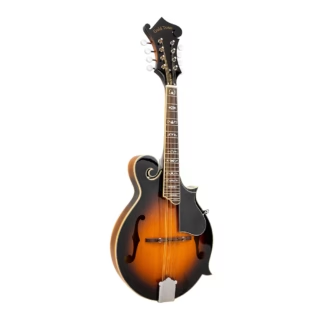
The history of the mandolin is a rich tapestry stretching back centuries, with its origins rooted in the evolution of European lutes. Early forms of the mandolin began to emerge in 17th-century Italy, developing from the mandola, a larger instrument. The "Neapolitan" or "bowl-back" mandolin, characterized by its deep, rounded back resembling a sliced pear, became popular in the 18th century, particularly in Italy, where it was embraced by classical composers like Vivaldi and Mozart. This era saw the mandolin used in chamber music and operas, showcasing its delicate and expressive capabilities. The late 19th and early 20th centuries marked a significant period of evolution and popularization for the instrument, especially in America. Italian immigrants brought their mandolins, and the instrument found new life in vaudeville, ragtime, and various folk ensembles. This period also saw the development of new designs, notably the flat-back and arch-top mandolins. Orville Gibson, an American luthier, revolutionized mandolin construction around the turn of the 20th century by applying violin-making principles, creating the carved-top and carved-back instruments with f-holes (like a violin) that define the "F-style" and "A-style" mandolins prevalent in bluegrass and American folk music today. These innovations significantly increased the mandolin's volume and projection, making it suitable for louder ensembles and solidifying its place in American string band traditions.
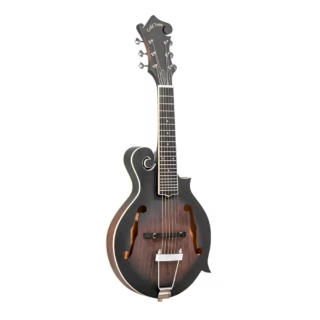
The construction of a mandolin, particularly modern arch-top varieties, is a testament to sophisticated woodworking and acoustic design principles. The instrument primarily consists of a body, a neck, and a headstock, all meticulously crafted to produce its distinctive sound. The body of an arch-top mandolin is carved from solid pieces of tonewood, typically spruce for the top (soundboard) and maple for the back and sides. The arching of these carved plates, similar to that of a violin, is crucial for projecting sound and providing structural integrity. The body features either oval soundholes (common on A-style mandolins for a warmer, more open tone) or f-holes (characteristic of F-style mandolins, providing a more focused and cutting sound often preferred in bluegrass). Inside the body, carefully shaped internal bracing supports the top and helps distribute vibrations.
The neck, typically made of maple or mahogany, extends from the body and provides the foundation for the fretboard. The fretboard, usually crafted from ebony or rosewood, features metal frets, which are smaller and more numerous than on a guitar due to the mandolin's shorter scale length and higher pitch. At the end of the neck is the headstock, which holds the tuning machines. These tuners, often worm-gear mechanisms, allow for precise adjustment of the string tension. The eight strings, almost exclusively steel, are anchored at a tailpiece on the lower bout of the body. They then pass over a movable bridge, which rests on the carved top and is critical for transferring string vibrations. From the bridge, the strings run over a nut at the top of the fretboard and are finally wound around the tuning pegs. The double-string courses provide the mandolin's unique shimmer and sustain when played with a tremolo, making its construction a harmonious blend of form and function designed for articulate and bright musical expression.